Movinti

Construction ERP for main contractors

The margin, while there is still time to change it.

Most contractors learn what a job made after the final certificate is paid. Movinti runs the tender, the subcontract, the payment certificate, the retention and the site on one database — so the number is there on the day you ask for it.

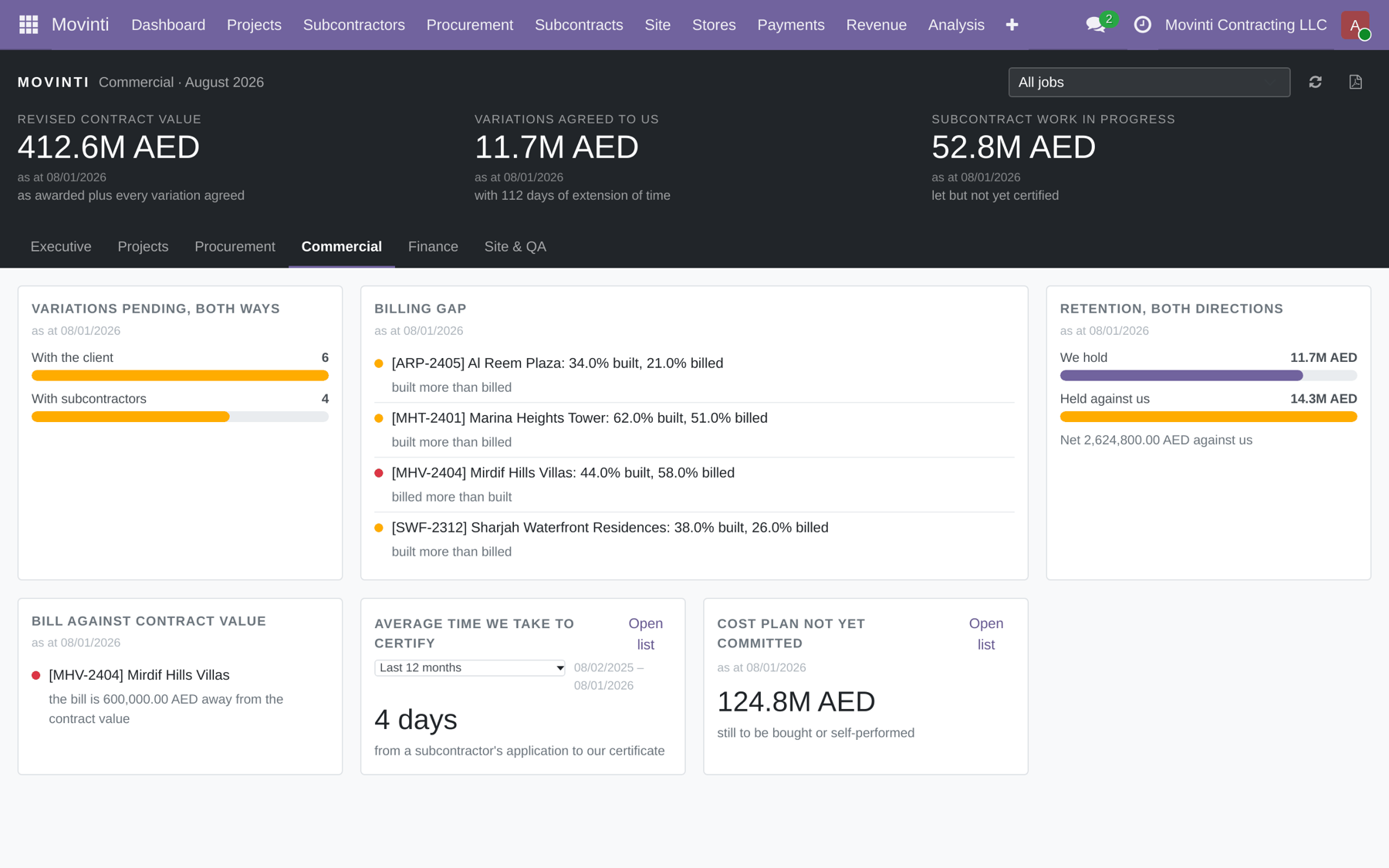
The Movinti Commercial board: revised contract value, variations agreed, subcontract work in progress, the billing gap and retention held in both directions.
60+

Contracting companies served1

2015

Delivering ERP in the Gulf since

3

Markets — Egypt, Saudi Arabia, the UAE

17

Modules, one database, one business

Movinti is built and implemented by Faceela FZE LLC, an accredited Odoo partner in the Sharjah Free Zone. The same people wrote the software and run the implementation.

Why this one is different

You have done this before.

A year of consultants. A configuration nobody in the office can explain. A system the site never opened — and a set of spreadsheets that quietly kept running the company underneath it.

The software was rarely the problem. The problem was that it knew nothing about a payment certificate, a retention cap, an advance recovery, a back-charge or a free-issue reconciliation. So somebody held all of it in Excel anyway, and the ERP became a place where invoices were typed twice.

Movinti is built the other way round. Every argument a contractor has — what was measured, what was certified, what is held, what was issued, who approved it — is a record with a state, an owner and a date. Nothing is written straight to a final figure, and nothing lives on somebody's laptop.

And we will tell you when it is not the right fit. That is the whole reason a vendor-neutral consultancy is worth talking to.

The system

Seventeen modules that only make sense together, on one database.

Movinti runs on Odoo 19, so the accounting, purchasing, inventory and payroll a contractor already needs are in the same database as the commercial life of the contract — not bridged to it.

Commercial

Project Controllifecycle · cost plan · programme
Revenue & IPCcontract bill · variations to us
Subcontractsaward · variations · retention
Progress Claimsapplications · certification

Cost & buying

Estimatingprice book · rate build-ups
Procurementpackages · bids · levelling
Analyticscost reports · printed documents
Data ImportBOQ · vendors · opening balances

Site & materials

Site Managementinstructions · NCR · punch · logs
Stores & Materialbins · receipts · issues · counts
Materials Controlsubmittals · free issue · MOS
Vendor Portalbids · claims · certificates

Foundation

BaseKYC · approvals · compliance
Dashboardsix role boards
Documentationthree manuals, inside Odoo
UAE E-InvoicingPINT AE · UBL 2.1

Tender to award

Let a package without a single emailed spreadsheet.

01

The package carries the bill.

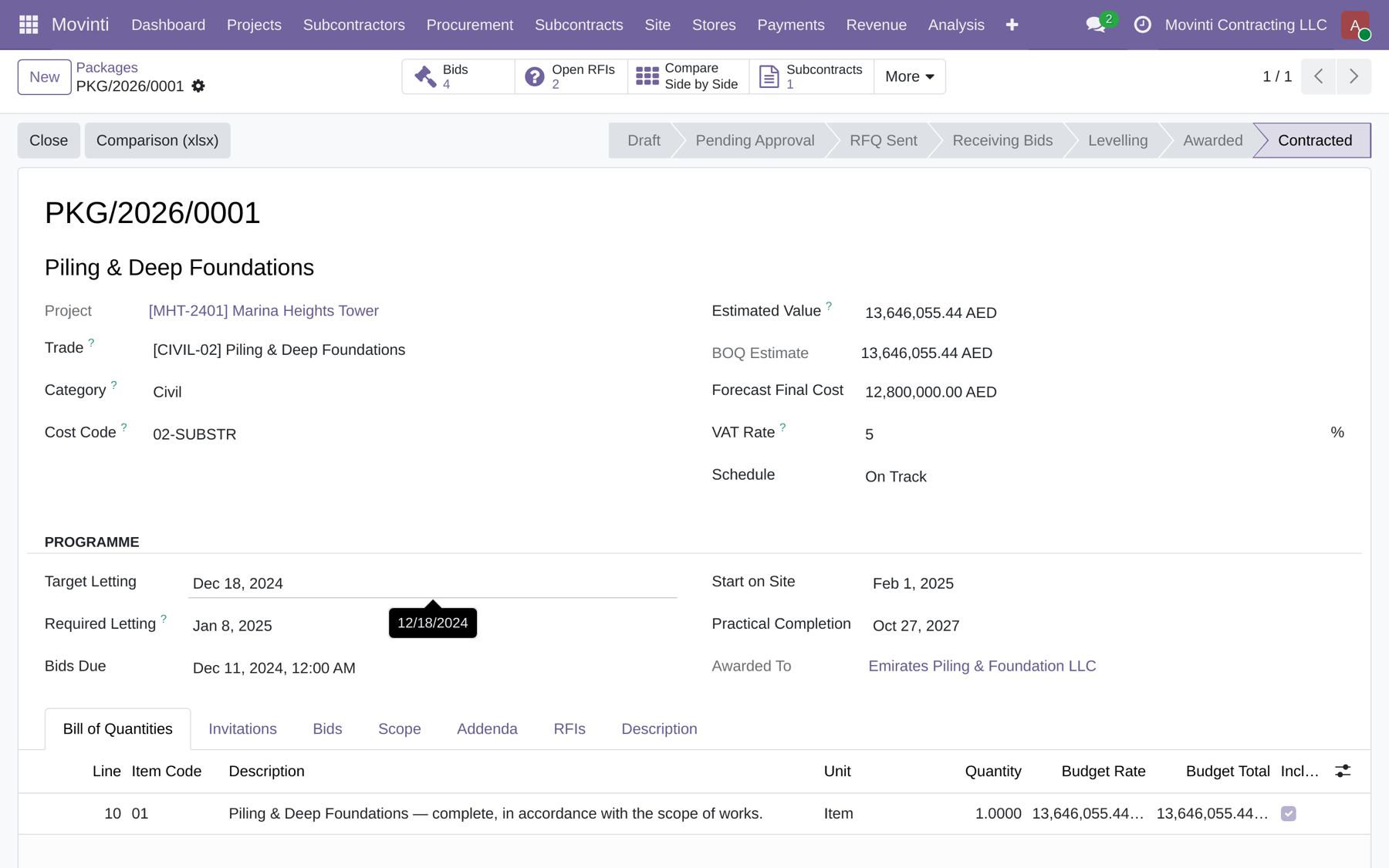
A trade package holds its bill of quantities, a scope of works assembled from reusable work elements and versioned, and every addendum and RFI numbered against it. Each line carries the budget rate it was estimated at, so the gain or loss on the buy is visible the moment a price lands.

  • Draft → Pending Approval → RFQ Sent → Receiving Bids → Levelling → Awarded → Contracted
  • Rates built from a dated price book of resources, with waste allowance, overhead and profit
A trade package with its bill of quantities and budget rates.
02

The subcontractors price it themselves.

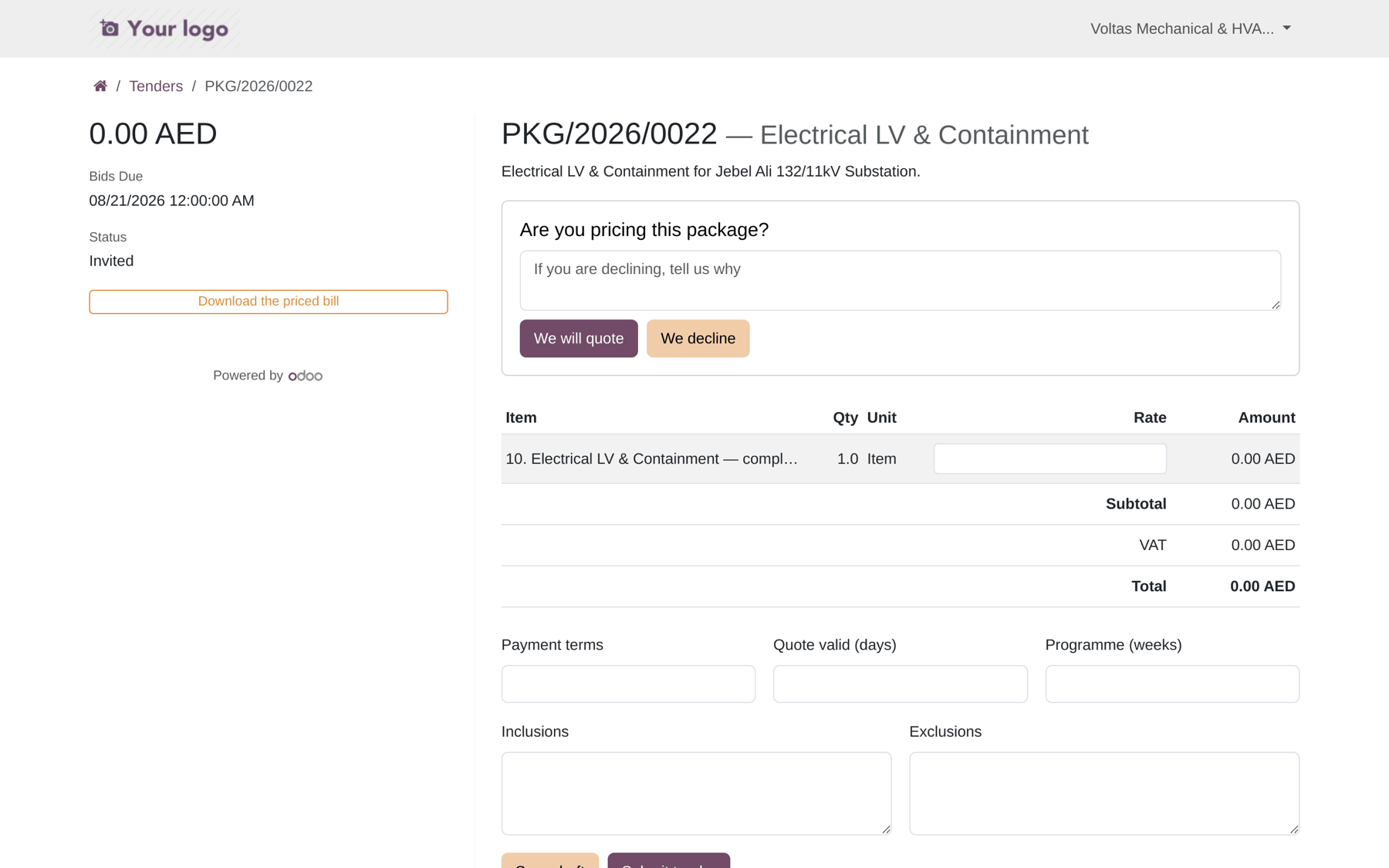
Invited subcontractors sign in to the portal, register an intent to quote or decline, and price the bill line by line. Nothing arrives as an attachment and nothing is retyped. They see their own tender and their own documents — the record rules fence every portal user to his own commercial partner, so no subcontractor ever sees another's price.

A subcontractor pricing the bill of quantities in the vendor portal.
03

The levelling grid decides, and the losers are released.

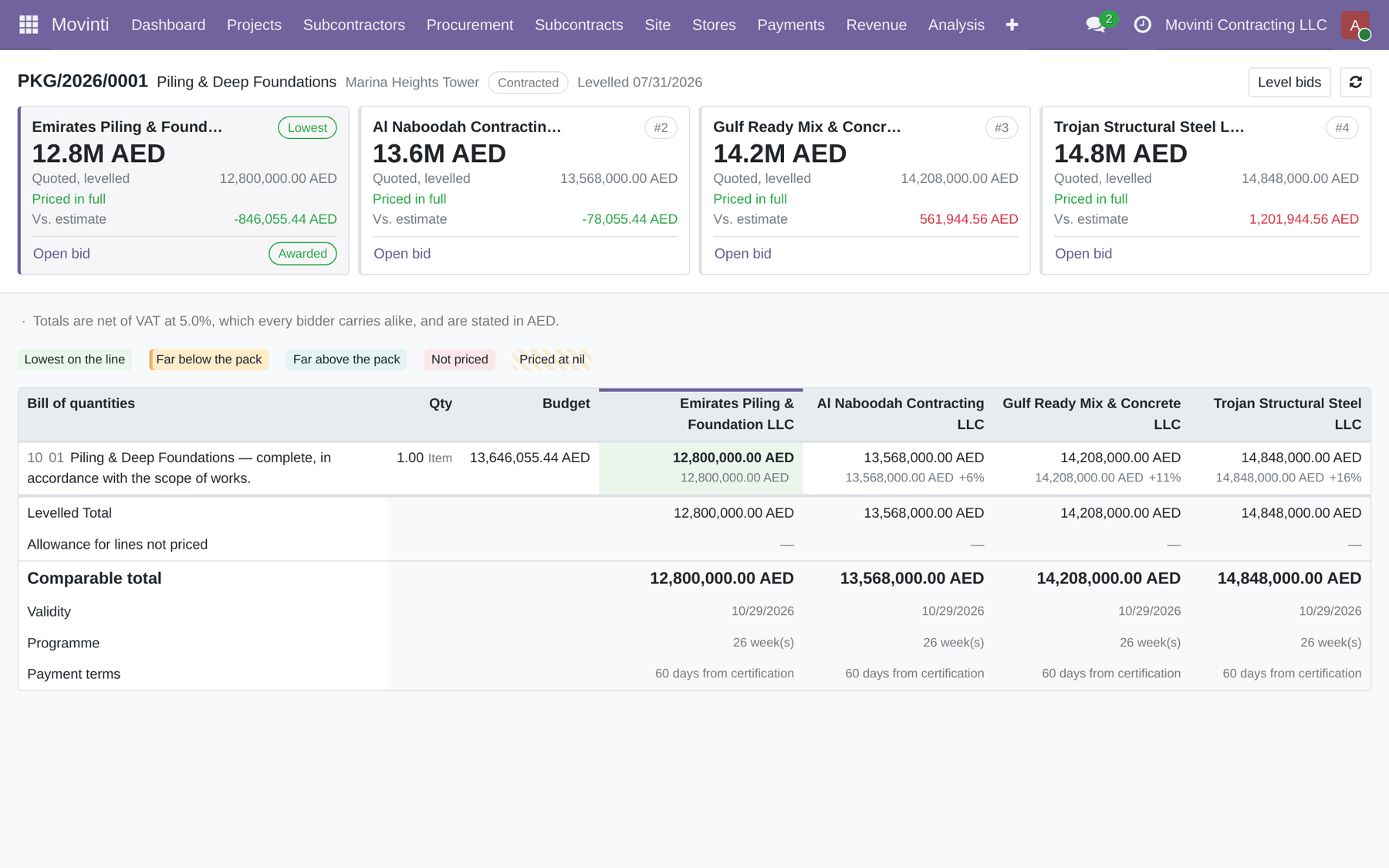
Bids land side by side, normalised and scored. Outliers are flagged per bill line by an interquartile fence, so the one rate somebody misread is caught before it becomes a subcontract. Award enforces a single winner. Regret letters are held until the winning subcontract is actually signed — because a package with no signature and no underbidders is how a contractor loses a trade twice.

The commercial levelling grid comparing bids line by line.
A trade package with its bill of quantities and budget rates.
A subcontractor pricing the bill of quantities in the vendor portal.
The commercial levelling grid comparing bids line by line.

Cost, certificate, retention

A certificate that is measured, not typed.

01

Budget, committed, actual — on the same line.

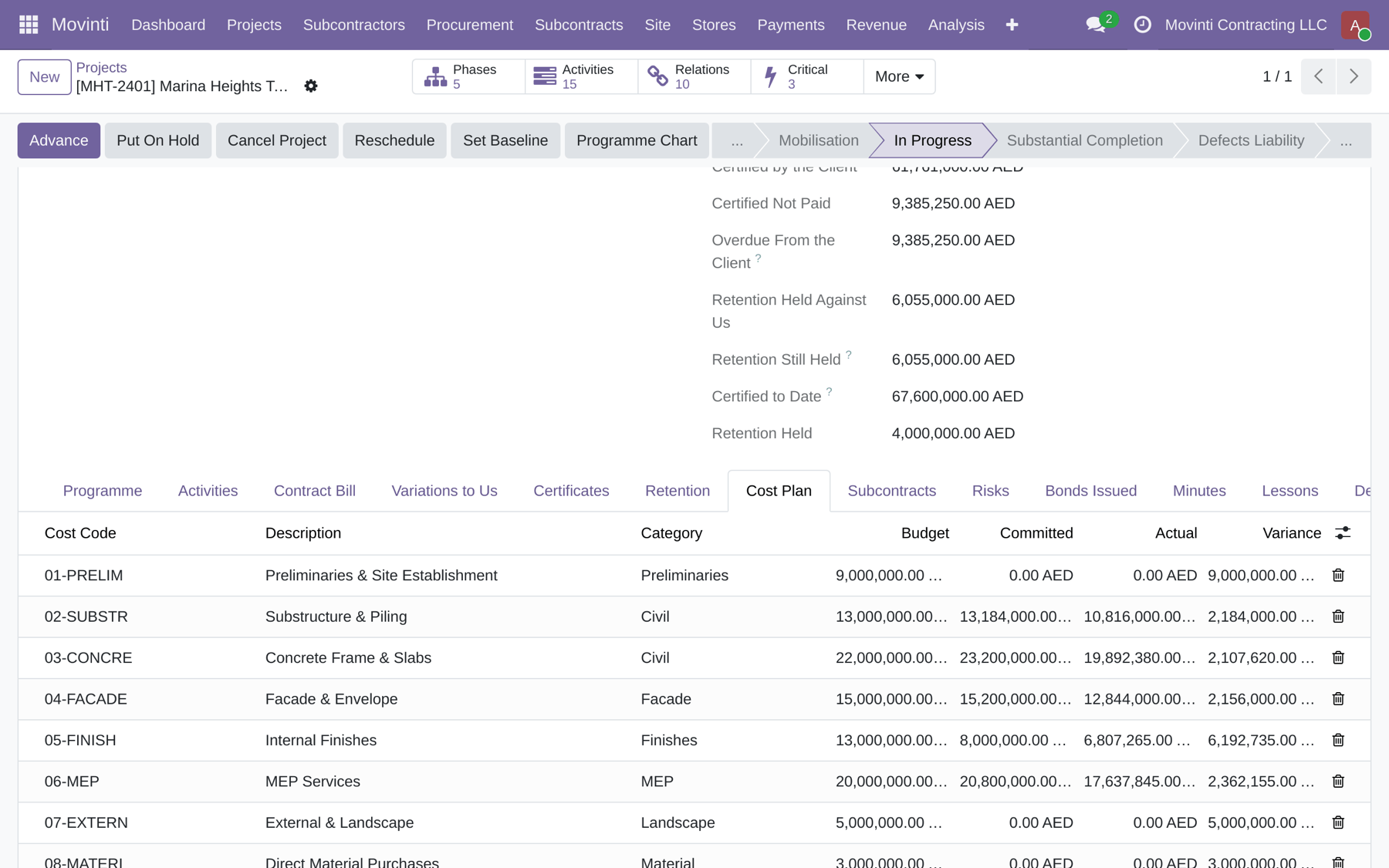
Every cost code carries what was budgeted, what has been committed and what has actually been spent. Signing a subcontract commits its value to the code. Certifying a claim writes the certified value as actual. A day sheet puts the gang and the machine on the code the day they worked, so labour and plant — the two buckets contractors lose money on — are in the cost plan beside the material, not estimated at month end.

The project cost plan showing budget, committed and actual per cost code.
02

The build-up is the certificate.

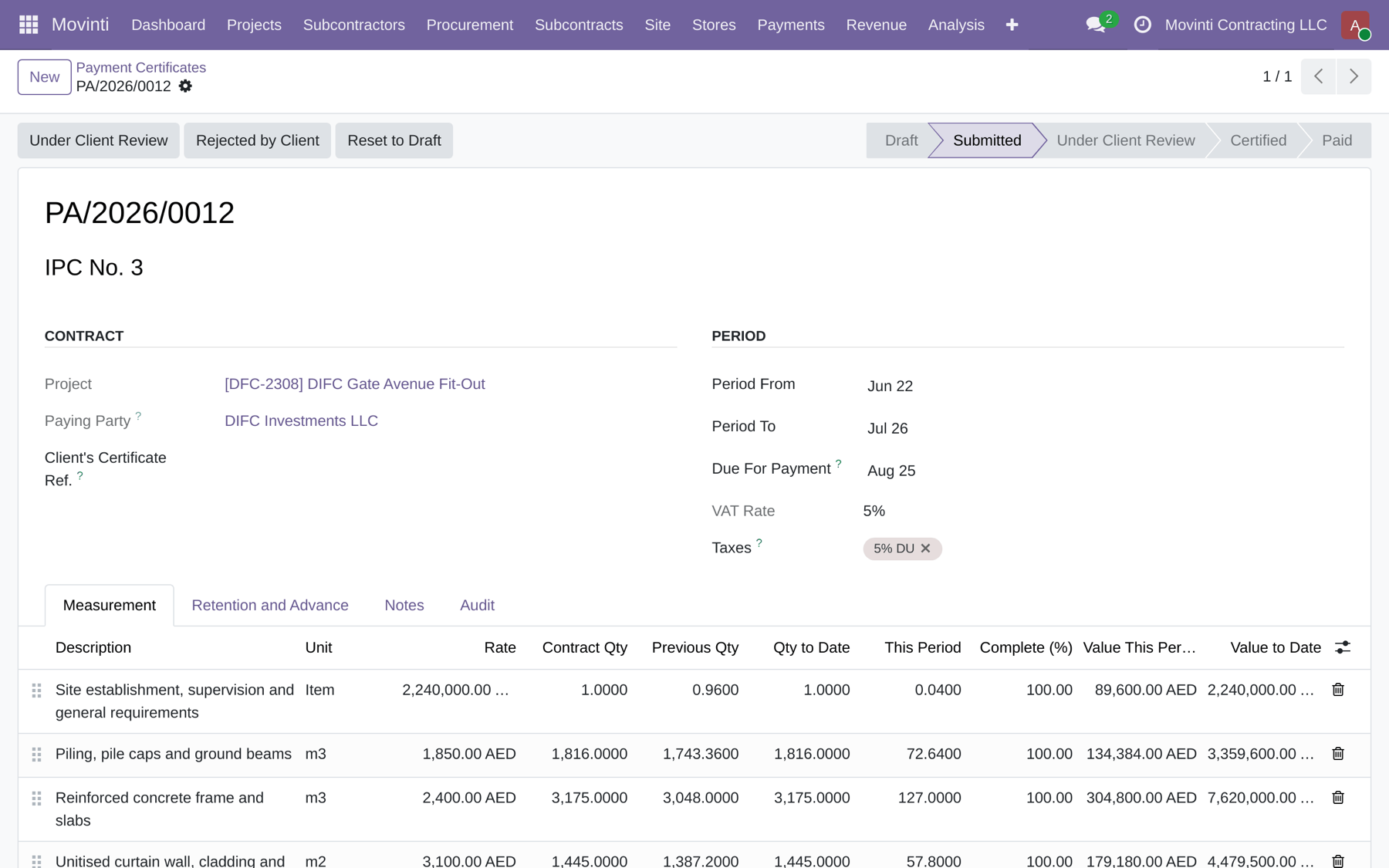
Cumulative to date: the value of work done, plus material on site under FIDIC 14.5, less retention at the contract percentage and capped at its limit, less the advance recovered pro rata, less every prior certificate, plus VAT. Certifying raises the invoice, coded to the analytic account. Nobody writes a state directly — the certificate walks Draft, Submitted, Under Client Review, Certified, Paid.

An interim payment certificate measured line by line, cumulative to date.
03

The retention comes back on a date, not on a reminder.

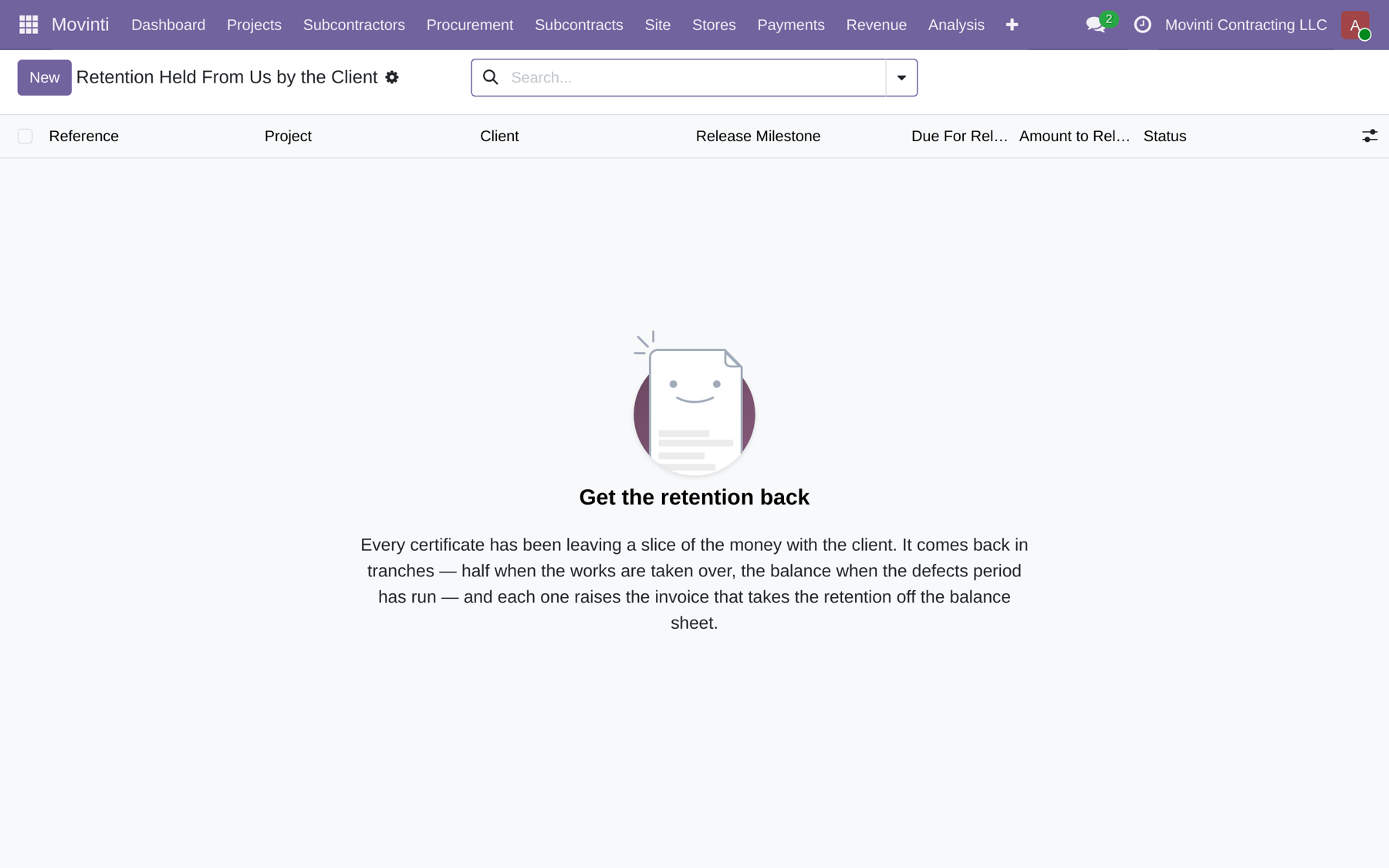
Held in both directions — what the client holds against you, and what you hold against every subcontractor — and released in tranches: half at practical completion, the balance at the end of the defects liability period. Each tranche raises its own invoice on its own date. The number nobody could ever find in Excel is a row with a due date.

Retention tranches with their release milestones and dates.
The project cost plan showing budget, committed and actual per cost code.
An interim payment certificate measured line by line, cumulative to date.
Retention tranches with their release milestones and dates.

Site and materials

The half of the job that never reaches an ERP.

Instructions, inspections, non-conformances, submittals and the store. This is where the money is actually lost, and it is usually the part a general ERP asks you to keep in Excel.

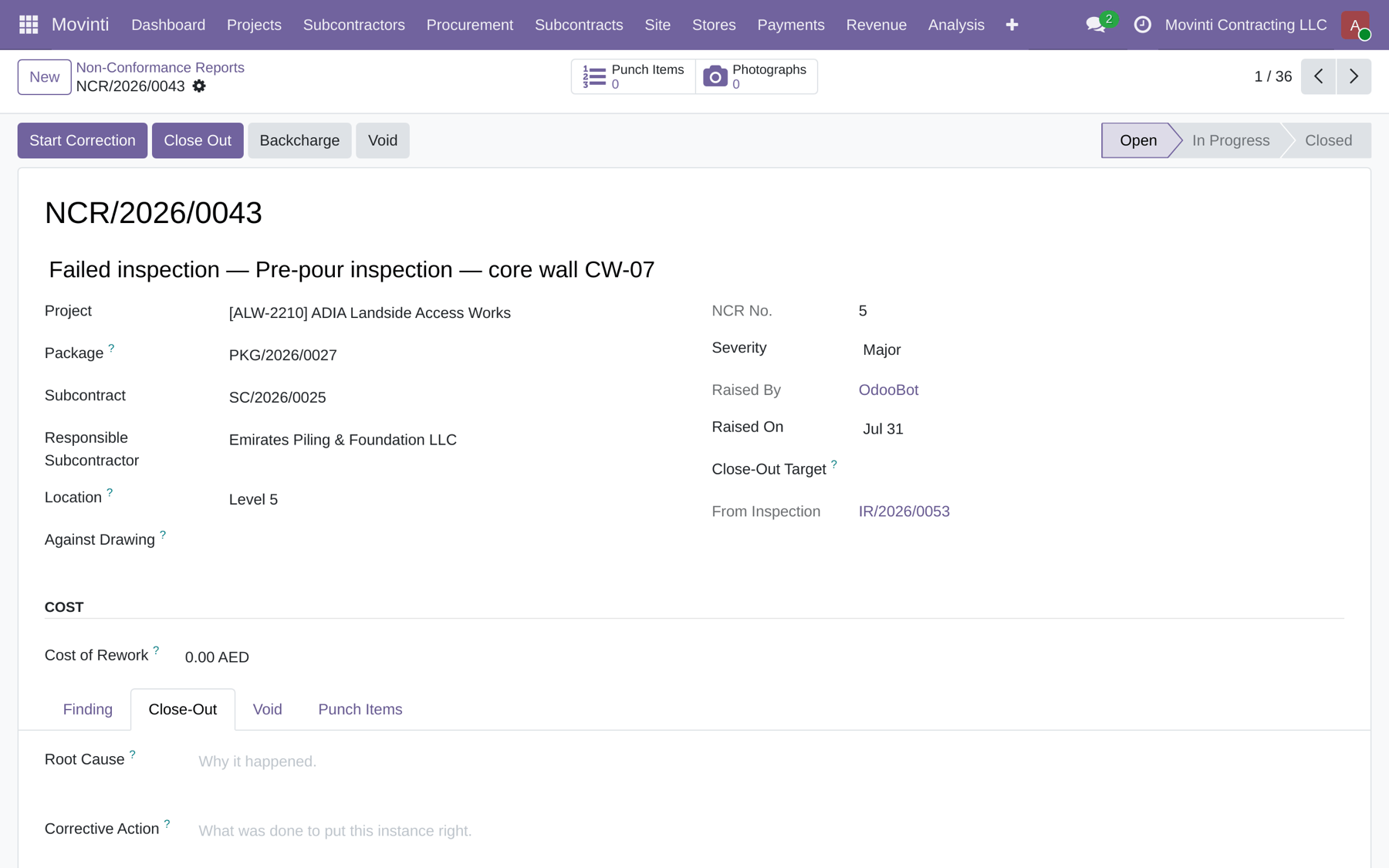
A non-conformance that closes properly.

Inspections run Requested → Scheduled → Inspected → Passed, Failed or Conditional, and a failure raises the NCR itself. The NCR is numbered per project and will not close without a root cause and a corrective action. If the fault was the subcontractor's, the rework is back-charged to his subcontract as a negative variation — from the same screen, on the record, not in a letter.

A non-conformance report being closed out with root cause and corrective action.

No purchase order without an approved submittal.

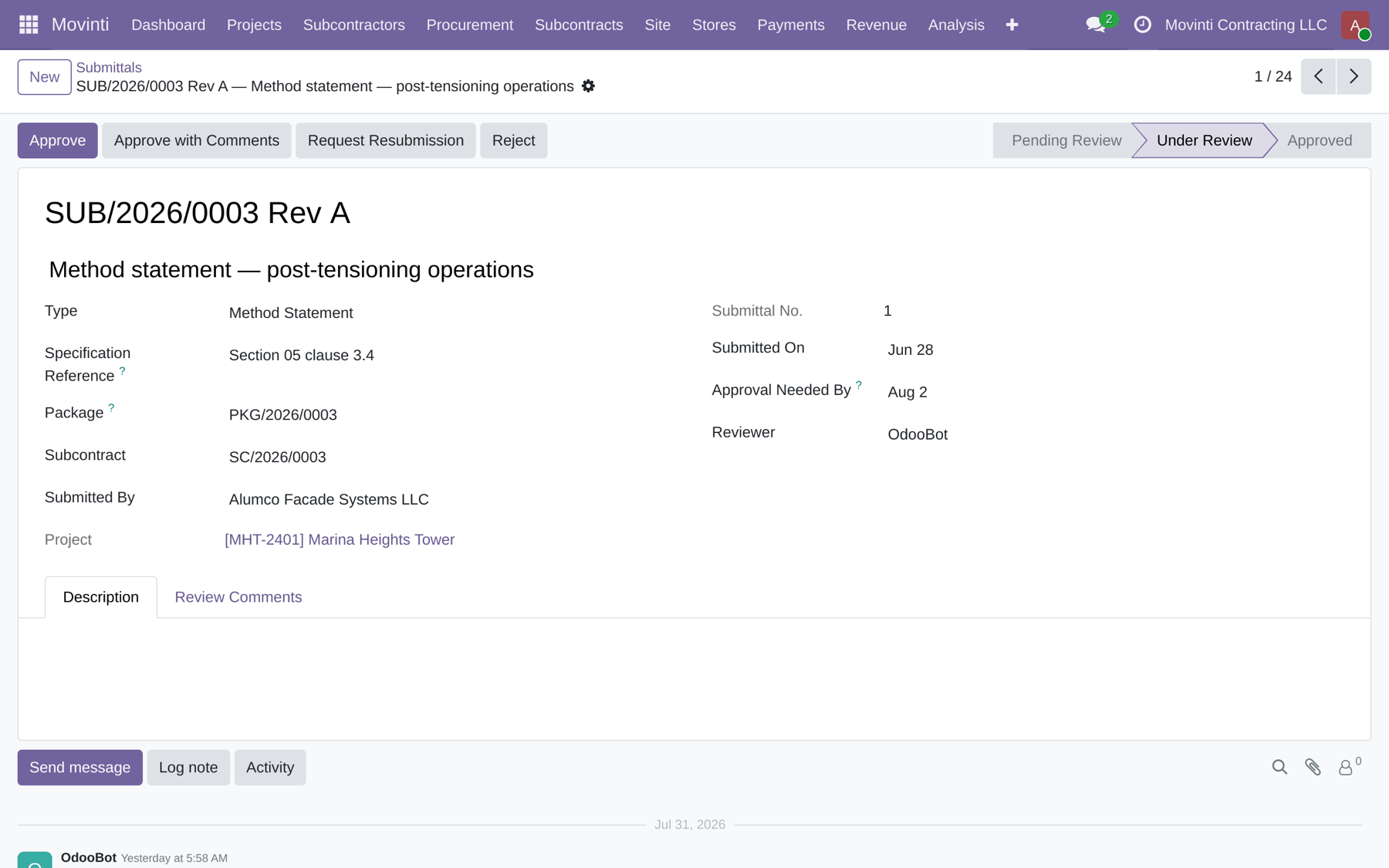
The consultant approves the brand and the source before the material can be bought. Until he has, the purchase order is refused — with the reason on screen, naming the material and the project.

A material submittal awaiting consultant approval.

The gate, on the record.

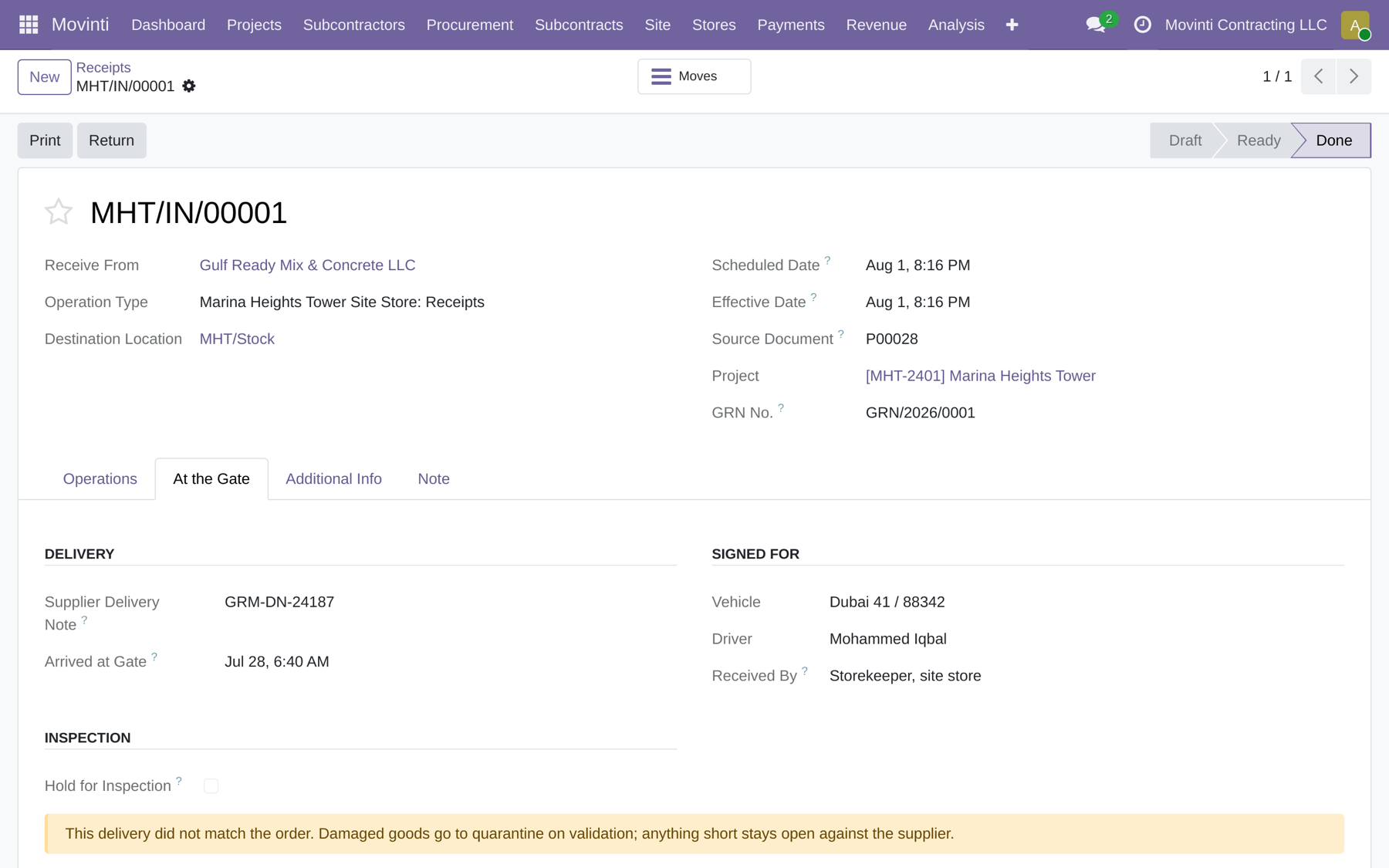
Goods receipt captures the vehicle, the driver and the signature, and records what arrived over, short or damaged. Marked categories are inspected on receipt: a pass releases the material to its bin, a failure raises an NCR.

A delivery being received at the site gate with vehicle and driver recorded.

Free-issue material, reconciled — and the difference charged back.

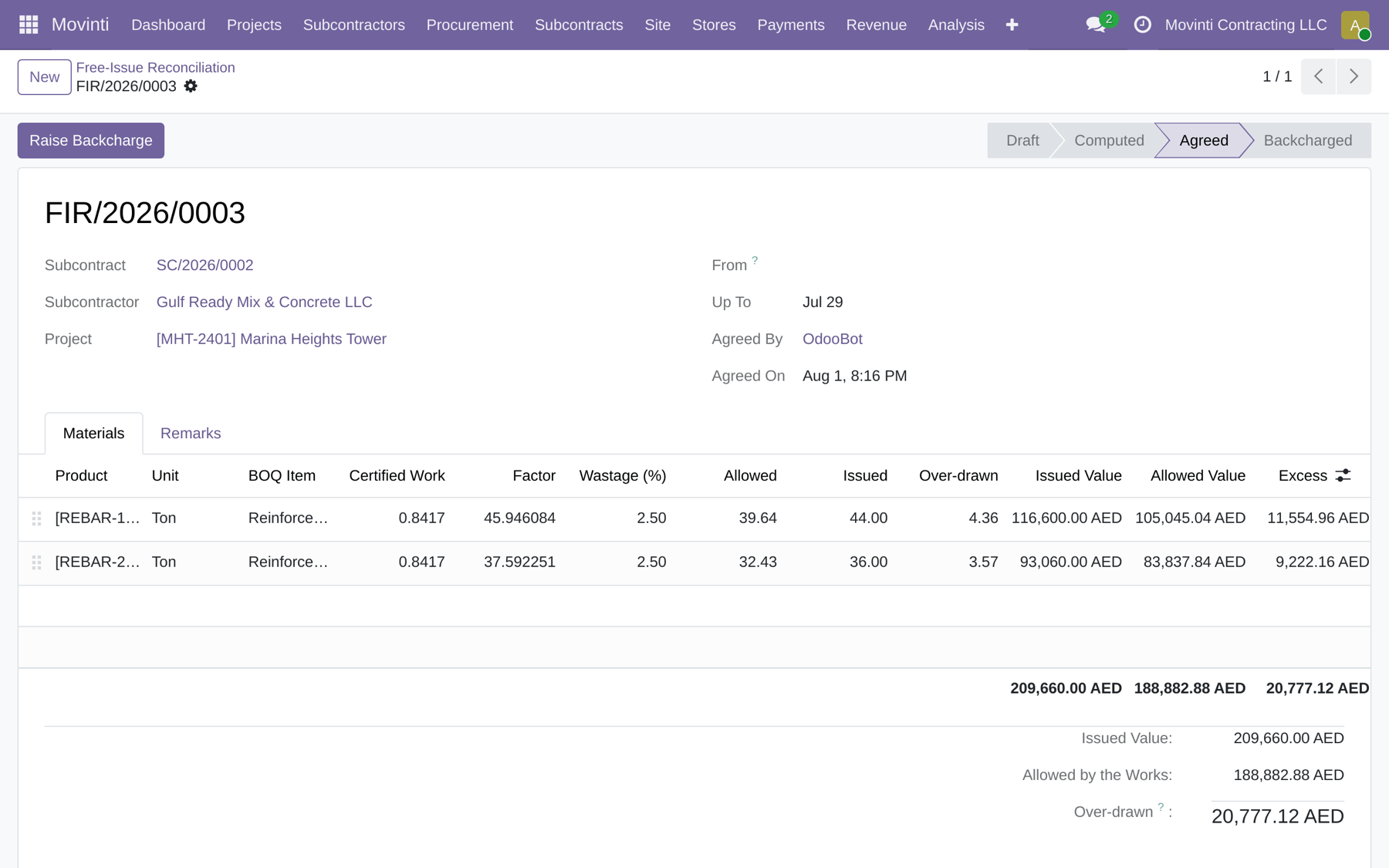
Steel and blockwork issued to a subcontractor are set against the work he actually got certified for, at the conversion factor and wastage allowance written into his subcontract. Under-draw on one material nets off over-draw on another. What is left over-drawn becomes a back-charge variation on his contract, priced, with the calculation attached. This is the conversation every contractor has once a month and almost never wins.

Free-issue reconciliation showing issued against allowed quantity and the over-drawn value.

Six boards

Every figure links to the rows that made it.

Nothing is cached and nothing is keyed in. Each tile is computed live from the records, and clicking it opens them. A board you cannot audit is a board nobody believes twice.

Executive

Order book, certified, cash locked up

Built against billed against spent, per job. Headroom over the cost plan. Programme slippage in days.

Projects

Progress against programme

Weighted portfolio progress, days late, and exactly what is stopping each job advancing to its next contractual step.

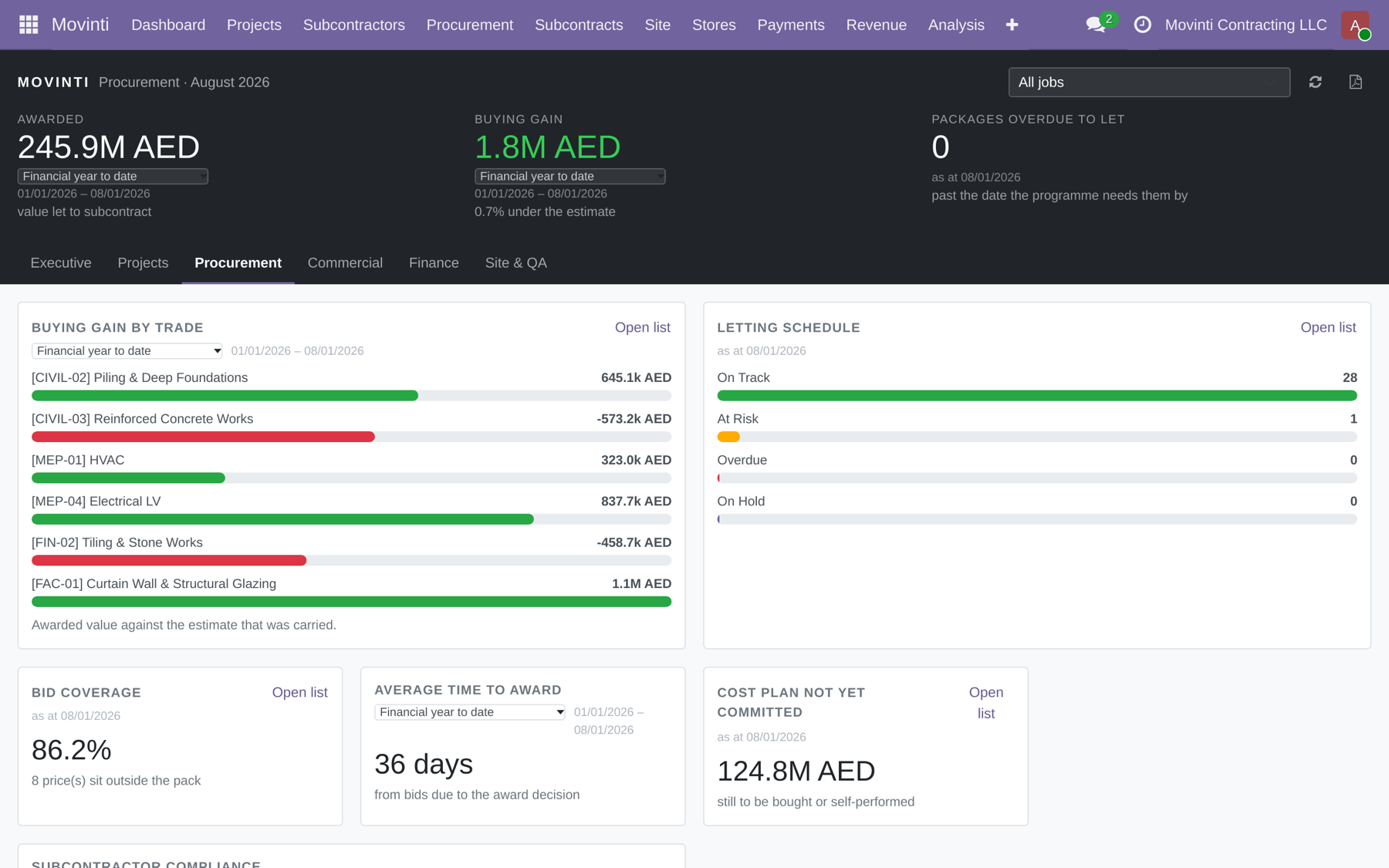
Procurement

Buying gain by trade

Awarded value against the estimate carried, the letting schedule, bid coverage, and subcontractor compliance about to expire.

Commercial

Variations both ways

Revised contract value, the billing gap where built and billed diverge, retention in both directions, and how long you take to certify.

Finance

Certified, not paid

Aged both ways in 30-day buckets, net position, advance still to recover, VAT on certificates in the period.

Site & QA

Non-conformances and rework

Open NCRs by severity, the priced cost of rework, inspections passed first time, punch items, submittals awaiting approval.

The Procurement board showing awarded value, buying gain by trade and the letting schedule.

The Gulf, properly

Not a localisation bolted on afterwards.

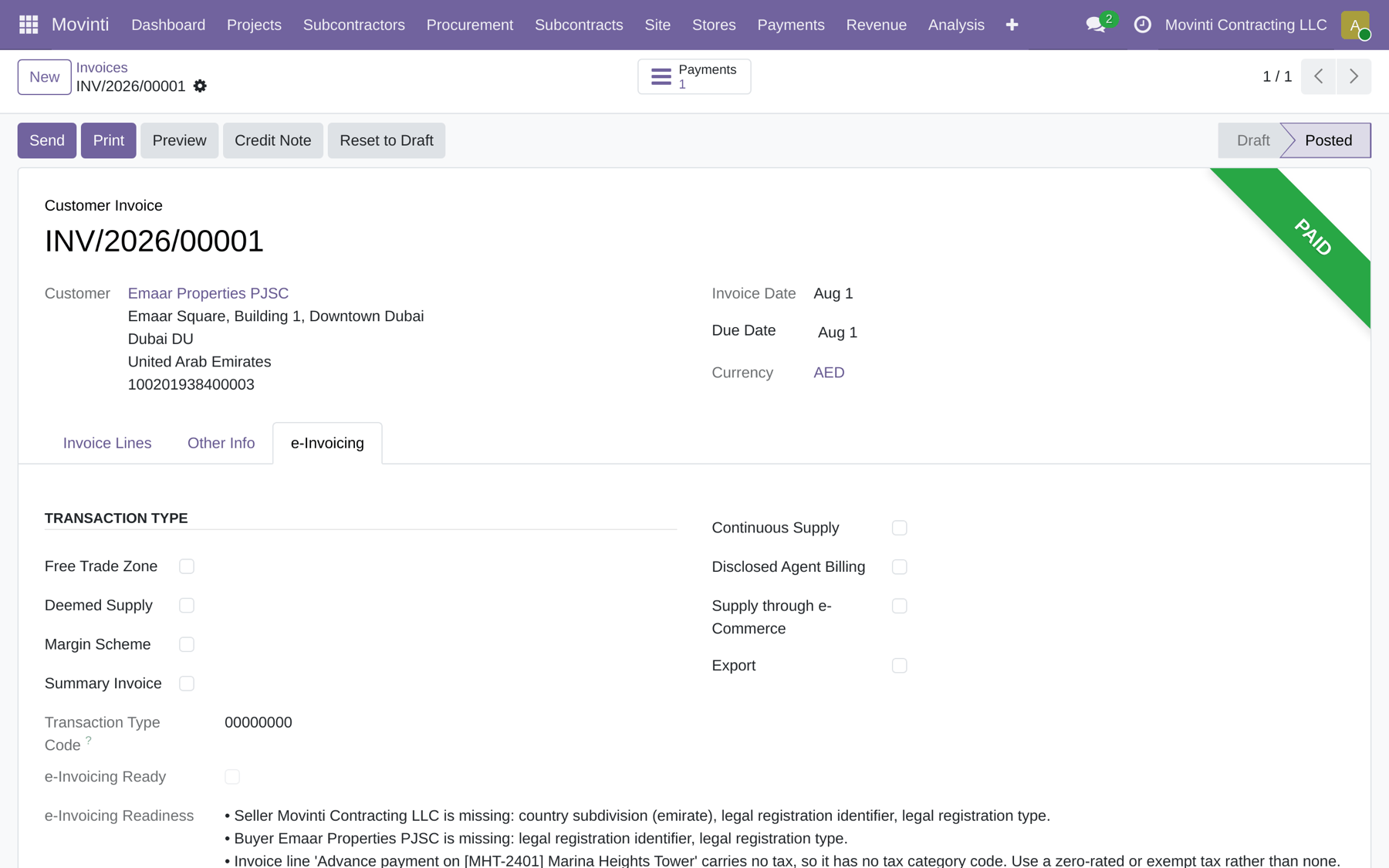
TRN, trade licence and emirate are fields on the company and on every counterparty. The suite ships in Arabic, and so do all three manuals. The e-invoicing work was written for the UAE mandate, not adapted from somewhere else.

UAE e-invoicing

FTA PINT AE Peppol participant identifiers derived from the TRN, mandatory-field validation before a document can post, a UBL 2.1 payload, and a transmission seam any Accredited Service Provider can be plugged into.2

Arabic, throughout

Every screen, every printed certificate and all three manuals. The test suite itself runs on an Arabic database, so a broken translation fails the build rather than surfacing at a client.

The expiry register

Trade licence, contractor all-risk, third-party liability, workmen's compensation, professional indemnity, performance bond, advance bond, bid bond, maintenance bond. Each with a date, a state, and a letter that goes out before it lapses.

Your data, always

PostgreSQL. Exportable in full, at any time. Cloud or on your own servers, and you can move between them later. We will never disable the system or withhold data over a fee dispute — it is a clause in the support annex.3

The e-invoicing readiness screen validating mandatory fields before a document is posted.

Delivery

Eight weeks to go-live. Written down before you sign.

Every week ends at a gate, and two of those gates are documents somebody signs. You get the plan and the support annex before the contract, not after it.

WEEK 0–1

Set up

Company, chart of accounts, users, roles, trades, cost-code structure. Configuration health check must come back clear.

WEEK 2

Opening data

BOQs, cost plans, vendors, programme and opening balances imported with a per-row error report. Gate: a signed balance-agreement minute.

WEEK 3

Training

By role, not by module. QS, accountant, storekeeper, site manager, sponsor. Every session recorded and left with you.

WEEK 4

UAT

Your people run the scenarios while we watch. We do not rescue them. Gate: a signed acceptance minute — this is your shield.

WEEK 5–8

Go-live, then hypercare

Never on a Thursday, never mid-close, never before a signed UAT. Three weeks of hypercare, then handover.

Warranty90 days

From signed go-live. Unlimited free defect correction, and thirty more days on anything corrected.

Critical response2 business hours

P1 in two hours, P2 in four, P3 in one day — contractual, with a remedy if we miss it.

Payment25 / 25 / 25 / 25

On signature, on opening data, on signed UAT, on go-live. Nothing is paid for work not yet accepted.

“The risk was never the logo on the software. It was the transformation — and nobody wrote that part down.”

Ahmed Hassan Algammal · Founder, Faceela FZE LLC
Author of Chaos of the System — on choosing an ERP and surviving the journey

Straight answers

What a buyer who has been burned actually asks.

What happens to our data if we stop paying you?

It stays yours and it stays available. The database is PostgreSQL and it is exportable in full at any time. We will never disable the system or withhold your data for any reason, including a fee dispute — that is written into clause 5.3 of the support and warranty annex, which you get before you sign anything.

Are we locked to Faceela?

No, and that is deliberate. Movinti runs on Odoo, an open platform with thousands of certified partners worldwide and a public data model. If you part ways with us, another implementer can take over. Ask every other vendor on your shortlist the same question: who else in this country can maintain your system if we fall out?

Does it work on site, on a phone?

Daily logs, punch lists, material requests and site photographs are used on a phone. The commercial work — measuring a certificate, levelling a tender — is desk work and is designed as desk work. Anyone claiming a full ERP is comfortable on a phone has not measured a bill of quantities.

What about our existing BOQs and balances?

Bills of quantities import from xlsx or CSV, with section headings recognised and units normalised to UN/ECE Recommendation 20. Cost plans, vendors (deduplicated on TRN), the programme with its predecessors, and opening balances come the same way. Every import is a dry run first and returns a per-row, per-column error report. Nothing is silently coerced — a bad row is reported, not guessed at.

Who actually implements it?

Faceela — the people who wrote it. Not a reseller, not a subcontracted delivery house. You will meet the project manager, the functional consultant and the technical engineer before you sign, and they are the ones who turn up.

How much does it cost?

The Odoo Enterprise licence is paid directly to Odoo at their published price — we take nothing on it, so you can check it yourself. Our implementation is quoted against your scope, and the annual maintenance contract is a percentage of it, stated as a number, with response times attached. We will send you the full three-year cost before the second meeting. If a vendor will not put a three-year figure in writing, that is your answer about the vendor.

Is Arabic real, or a checkbox?

Real. The interface, the printed certificates and all three manuals ship in Arabic, and the manual switches edition automatically for an Arabic-speaking reader. The automated test suite runs against an Arabic database, so a translation that breaks a screen fails our build rather than reaching you.

What does it not do?

It is not a design tool and it is not a BIM platform. It is not a replacement for Primavera on a mega-project programme, though it schedules a critical path and will hold your programme. It does not do 3D. It runs the commercial and cost life of a contract, the site paperwork attached to it, and the accounting underneath it — and it says so rather than claiming everything.

Bring one live job. We will run it in front of you.

Not a slide deck of features. One of your real contracts — its bill, a subcontract, a certificate, the retention — walked through the system in thirty minutes, so you can see whether the numbers come out the way you already know they should.

We reply within one business day. Your details go to Faceela FZE LLC only, and are never sold or shared. Prefer email? support@movinti.com